环境、分类学和社会经济因素可以预测淡水鱼类是否濒危
Environment, taxonomy, and socioeconomics predict non-imperilment in freshwater fishes
Christina A. Murphy · J. Andres Olivos · Ivan Arismendi · Emili García-Berthou · Sherri L. Johnson · Jason Dunham
1. 信息
期刊Nature Communications / Nat Commun
类型Article
发表2026-02-16 (online)
卷期页17(1): 1661
收录2026-10-04
被浏览…
关键词freshwater fishIUCN Red Listbiodiversity risk assessmenthabitat disturbancehydrological characteristicstaxonomic ordermachine learning classificationrandom forest
标签—
2. 摘要
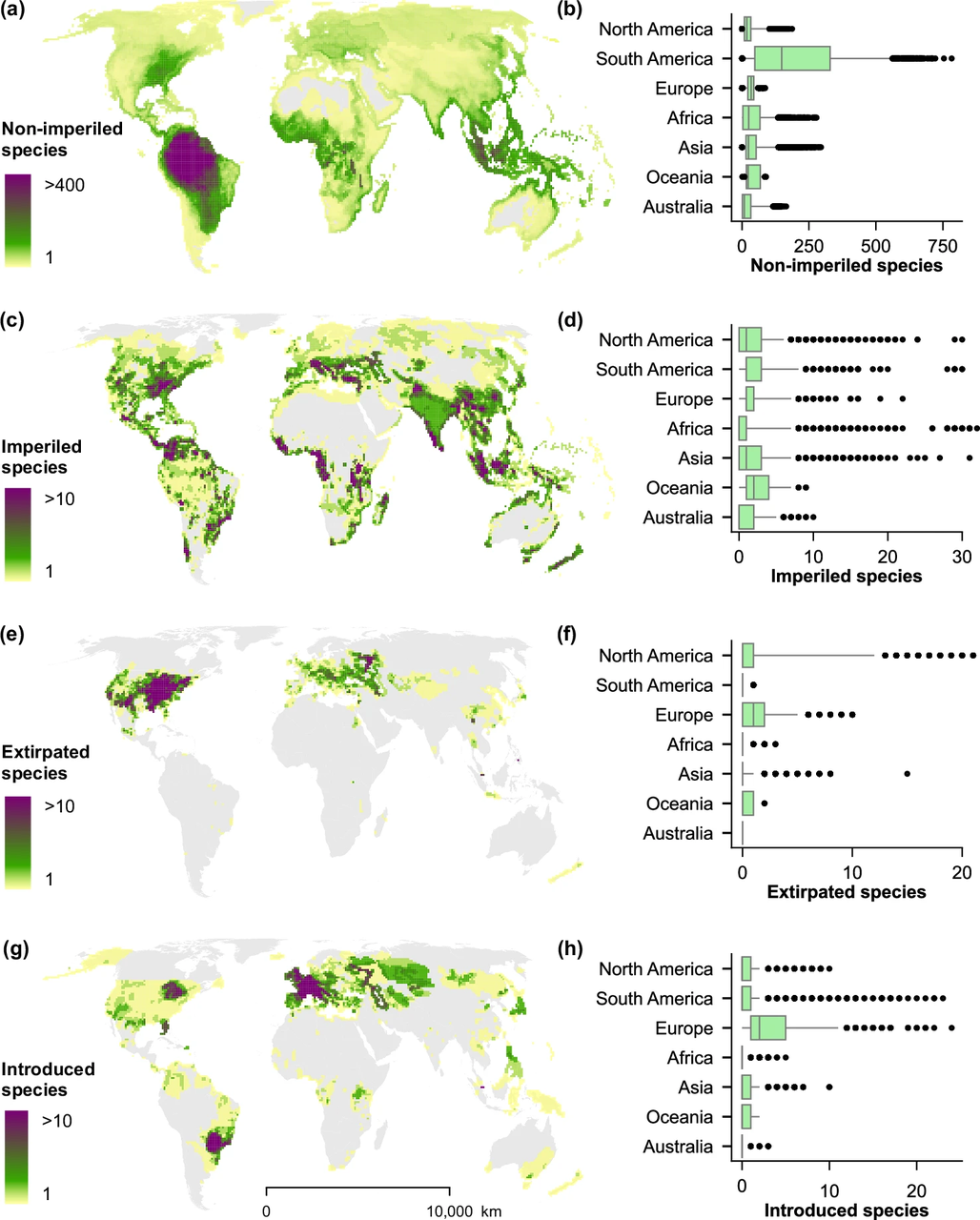
淡水鱼类是受威胁最严重的类群之一,但许多物种的保护评估仍不完善。淡水鱼类提供重要的生态系统服务,例如食物保障、休闲娱乐和文化意义。尽管淡水生态系统已发生巨大变化,但物种对濒危物种的敏感性和抵抗力的原因尚不明确。为了解决这一问题,我们开发了一个机器学习框架,利用一套全面的环境、社会经济和物种内在特征预测因子,预测10,631种淡水鱼类的全球濒危状况。我们使用更新后的IUCN红色名录数据,训练并验证了随机森林分类器,以区分濒危物种(易危、濒危、极危)和非濒危物种。我们研究了来自12个全球数据源的52个变量的相对影响,这些变量描述了外部环境和社会经济因素以及物种特有的内在特征。我们的模型对非濒危物种的预测准确率(90.1%)高于对濒危物种的预测准确率(81.8%),这反映了导致濒危物种面临的威胁和环境条件的异质性更大。在所有模型中,关键预测因子包括栖息地变量、分类顺序、水文特征和干扰指标,凸显了生态、地理和人类活动压力之间的相互作用。这种综合性的、可重复的方法展示了机器学习在指导主动保护方面的实用性,并为全球生物多样性风险评估提供了一个可扩展的框架。
原文摘要(English)
Freshwater fishes are among the most threatened taxa, yet conservation assessments remain incomplete for many species. Freshwater fishes provide essential ecosystem services such as food security, recreational opportunities, and cultural significance. Despite heavy alterations to freshwater ecosystems, the reasons for species’ sensitivity and resistance to imperilment are unclear. To address this need, we develop a machine learning framework to predict global imperilment status for 10,631 freshwater fish species using a comprehensive set of environmental, socioeconomic, and intrinsic species-level predictors. Using updated IUCN Red List data, we train and validate Random Forest classifiers to distinguish imperiled (Vulnerable, Endangered, Critically Endangered) from non-imperiled species. We examine the relative influence of 52 variables derived from 12 global sources describing extrinsic environmental and socioeconomic factors and intrinsic species-specific characteristics. Our models achieve higher accuracy for non-imperiled species (90.1%) compared to imperiled species (81.8%), reflecting the greater heterogeneity of threats and conditions driving imperilment. Across models, key predictors include habitat variables, taxonomic order, hydrological characteristics, and disturbance indicators, underscoring the interplay between ecology, geography, and human pressures. This integrative, reproducible approach demonstrates the utility of machine learning for guiding proactive conservation and provides a scalable framework for global biodiversity risk assessment.
3. 图表
4. 引用
查看 BibTeX
@article{murphy2026,
  author = {Christina A. Murphy and J. Andres Olivos and Ivan Arismendi and Emili García-Berthou and Sherri L. Johnson and Jason Dunham},
  title = {Environment, taxonomy, and socioeconomics predict non-imperilment in freshwater fishes},
  journal = {Nature Communications},
  year = {2026},
  volume = {17},
  number = {1},
  pages = {1661},
  doi = {10.1038/s41467-025-68154-w},
  publisher = {Springer Science and Business Media LLC},
}
· END ·